Showing posts with label James Brainerd Taylor. Show all posts

Sunday, February 7, 2016

"That I may be useful is my desire"

In his brief 27 years, James Brainerd Taylor (1801-1829) longed to be useful to God. The striving uncommon Christian did his "best to present [himself] to God as one approved, a worker who has no need to be ashamed, rightly handling the word of truth" (2 Tim. 2:15). He sought to be "a vessel for honorable use" to God:
"Now in a great house there are not only vessels of gold and silver but also of wood and clay, some for honorable use some for dishonor. Therefore, if anyone cleanses himself from what is dishonorable, he will be a vessel for honorable use, set apart as holy, useful to the master of the house, ready for every good work."
2 Tim. 2:20-21
This desire of the Connecticut-born and Princeton University and Yale Seminary-educated Second Great Awakening evangelist is evident throughout his journals and letters--and what his contemporaries said about him--that are included in the once popular Memoir of James Brainerd Taylor (1833) and A New Tribute to the Memory of James Brainerd Taylor (1838). For instance, Taylor writes,
"My heart at times rejoices in the prospect of being useful to my fellow sinners, and at times it shrinks back from the many difficulties which rise to my view. The life of a faithful minister (and such may I be, if admitted to the office) appears to me to be more glorious than any other. He is prompted by true benevolence; he labors not to destroy men's souls, but to save them. He is engaged in a cause which must prosper, for Christ is the head [of the church, Col. 1:18]. He shall receive a reward according to Christ's promise [Rev. 22:12]."
~ age 18, November 16, 1819, New York City, letter to his parents in his native Middle Haddam, Connecticut
"The time necessary for me to go through the course marked out is eight years. I hope that in the discharge of my duty during this period [as a preparatory, university and seminary student] I may be useful."
~ age 18, November 1819, New York City, letter to his parents
"But while I set so great a value on a good education, I would not be understood to say that education is a matter of highest importance. Pure and undefiled religion [James 1:27] is the chief thing in the character of a minister of the gospel. Without it he cannot be useful."
~ age 18, November 1819, New York City, letter to his sister
"My wish is to glorify God [1 Cor. 10:31], and be useful to my fellow men. . . . If I can only be useful, it will be enough for me."
~ age 18, November 1819, New York City, letter "to a young friend"
 "I trust that I have not been called to this place for nothing. That I may be useful is my desire. If my heart does not deceive me, I long to spend and be spent for Christ [2 Cor. 12:15]."
~ age 19, July 12, 1820, Lawrenceville, New Jersey, letter to his fellow ministerial student friend 
 "And may I be an honor to my father, and to the mother who bore me! May I glorify my heavenly Father [1 Cor. 10:31] and be made a blessing to society! O may I not live like a cipher [a zero or a secret writing] in this world, but be made extensively useful. For this, let me ask your continual, earnest, united prayers."
~ age 20, December 1821, Lawrenceville, New Jersey, letter to his parents  
"I see nothing here to live for but to spend and be spent for God [2 Cor. 12:15]; and no longer than I may be useful would I remain here below."
~ age 22, May 1823, New York City, letter "to Miss W."
"Religion can be enjoyed in college. Lord, amidst so much iniquity, keep me spotless [2 Pet. 3:14], and make me useful." 
~ age 22, November 9, 1823, Princeton University (freshman), New Jersey, journal entry
"When I had given myself renewedly away to be the Lord's wholly [Num. 32:12, etc.], I longed to be useful, and felt willing to live and labor for souls." 
~ age 26, April 1827,  Trumbull, Connecticut, journal entry
"After all, I am a poor tool. Peradventure, my present hour [of serious physical illness and travels in the warmer American South] is to prepare me for greater usefulness. I know not the will of Him with whom is the future [James 4:13-15]. Enough to know that he now guides my footsteps."
~ age 27, April 19, 1828, Augusta, Georgia, letter to "his dear friends at the North"
"Should I recover [from tuberculosis], I shall look upon the varied dealings of God with me as happily preparatory for my future usefulness."
~ age 27, June 25, 1828, New York City, letter to family and friends in Middle Haddam, Connecticut

On the same day that the 27-year-old J. B. Taylor died of tuberculosis in the home of the prominent Southern Presbyterian John Holt Rice (1777-1831)--the home was located on the campus of Union Seminary (est. 1812) which itself was then situated on the campus of Hamden-Sydney College (est. 1775) in central Virginia--Rice wrote to Taylor's eldest brother and New York City businessman and Christian philanthropist, Knowles Taylor (1795-1850), on Sunday, March 29, 1829,
It devolves on me to perform a mournful service. . . . How mysterious this event! -- since it has appeared to me inevitable, that one so prepared for the ministry, and so desirous to be useful as our dear brother was, should die; the thought has often occurred to me, that there are services for very holy and devoted men, in a higher sphere, to which they are called, and where they do incomparably more for the glory of the divine Redeemer, and are more useful, than they could possibly be on earth. And while we are wondering that they should be cut off, and disappoint all our hopes of their usefulness, they probably do more in a day, in heaven, than they could do in a lifetime in this world. The Master had use for our brother above, and called for him. We would fain have kept him here. I confess that I never have seen a young man whom I so much wished should live.
Please join Uncommon Christian Ministries in prayerfully longing like James Brainerd Taylor to be made useful to God: "useful to the master of the house, ready for every good work" (2 Tim. 2:20-21).

Yet let's not make an idol out of usefulness: "My usefulness was the last idol I was willing to part with, but the Lord has enabled me to give even this up. I am now content to be laid aside, overlooked, neglected, and forgotten--only let his wise and holy will be done" (Cotton Mather, 1663-1728).


Philemon 1:10-11, New Testament


Tuesday, July 7, 2015

FOUND: Original oil paintings of James Brainerd Taylor and family members . . . "O, mamma, how happy I am that his portrait is left us. It will be a precious relic indeed"

After a 17-year, research-filled wait, the original 1828 oil painting (39" x 32") of James Brainerd Taylor (1801-1829) has been located. The June 29, 2015, finding came as a result of a periodic search inquiry on various online search engines regarding James Brainerd Taylor and select family members.

The background to the J. B. Taylor painting is explained in my An Uncommon Christian: James Brainerd Taylor, Forgotten Evangelist in America's Second Great Awakening (University Press of America, 2008, page 142):

"After five sittings and just three days prior to his departure for the South on November, 4, 1828, [Taylor's] portrait was completed in New York City by America's premier nineteenth-century portrait artists, Samuel Lovett Waldo (1783-1861) and William Jewett (1792-1874). In reflecting upon the portrait, Fitch Taylor penned words of tenderness addressed to his parents on April 3, 1829, just five days after James' death: 'O, mamma, how happy I am that his portrait is left us. It will be a precious relic indeed.'"

James Brainerd Taylor (1801-1829)

Age 27 (5 months before his death in Virginia)
October 1828, New York City

Painting (39" x 32") by Samuel Lovett Waldo and William Jewett

Courtesy of Connecticut River Museum. Essex, Conn.

Nameplate on the frame
to the original oil painting.

Dr. Francis Kyle. December 16, 2016.

Connecticut River Museum. Essex, Conn.

Also located in the same archival collection are the portrait paintings of Taylor's parents, Col. Jeremiah Taylor (1773-1849) and Lucy Brainerd Taylor (1777-1865), and two of his younger brothers, Fitch Waterman Taylor (1803-1865, the compiler/editor of A New Tribute to the Memory of James Brainerd Taylor, 1834) and Samuel Taylor (1813-1873). In all, twelve portraits of members of the five generations of the prominent Taylor family of Connecticut have been located by this Taylor family researcher. William Taylor (born ca. 1625) is the emigrant ancestor and progenitor of this particular branch of Taylors in America, having arrived in Connecticut from Lancashire County, England, in 1647.

The oil paintings are housed in the Stevens Library archival collections at the Connecticut River Museum in Essex, Connecticut. Essex is located along the Connecticut River some fifteen (river) miles south of Middle Haddam, Connecticut, the birthplace of J. B. Taylor.

I plan to include some of the newly discovered portraits in my hopeful third book on J. B. Taylor: Uncommon Christian Evangelism: Lessons for Today from James Brainerd Taylor. Both An Uncommon Christian and the companion volume, my edited anthology Of Intense Brightness: The Spirituality of Uncommon Christian James Brainerd Taylor (University Press of America, 2008), already include over 35 images in each book.

Lucy Brainerd Taylor (1777-1865)

Age 57
1834, New York City

Cousin (3x removed) of the famed missionary David Brainerd (1718-1747)

Painting (30.5" x 34.5") by Frederick R. Spencer

Courtesy of Connecticut River Museum. Essex, Conn.

My research and writing on J. B. Taylor began after buying the Memoir of James Brainerd Taylor, Second Edition (1833) for $10 at a used bookstore in Manchester, Connecticut, in July 1998. In the memoir's frontispiece is a black-and-white engraving of the portrait painting. My research into finding the hoped-for still existent original painting had included phone calls to various art galleries throughout the U.S. that housed art works by the painters Waldo and Jewett, including the National Portrait Gallery in Washington, D.C. But it was not until 2015 that I was able to finally locate the original oil painting. Up until now, the only known extant portrait of any of J. B. Taylor's immediate family was a sketch of Jeremiah Humphre Taylor (1797-1882), one of James' two older brothers, that appeared in Henry Anstice's History of St. George's Church in the City of New York, 1752-1811-1911. (See figure 10 in An Uncommon Christian, and figure 10 in Of Intense Brightness.)

Here are the three Hartford Courant newspaper articles (1995, 1997, 2002) that have been posted online and that have provided this independent researcher with new information about this particular branch of the Taylor family of Connecticut. William Taylor (born ca. 1625) is the emigrant ancestor and progenitor of this particular branch of Taylors in America, having arrived in Connecticut from Lancashire County, England, in 1647.

"Portraits of Family Find a Home at River Museum"
March 7, 1995
Hartford Courant

"St. Clements Comes Out of Hiding: Estate Leads Portland's Renaissance"
December 7, 1997
Hartford Courant

"Ask the Courant: St. Clements in Portland, Conn."
July 8, 2002
Hartford Courant

Col. Jeremiah Taylor (1773-1849)

Age 61
1834, New York City

Collateral descendent of Church of England literary giant Jeremy Taylor (1613-1667),
considered the "Shakespeare of Divines"

Painting (36" x 31") by Frederick R. Spencer

Courtesy of Connecticut River Museum. Essex, Conn.

Some of the highlights from the three articles--combined with some information provided by the Connecticut River Museum curator, Amy Trout--include the following:

+ The Taylor family name/line ceased on October 16, 2003, with the death of Prudence Taylor Palmer (1931-2003, born New York City, died Portland, Connecticut). According to her obituary, "As an only child and the last in the Taylor line, Mrs. Palmer inherited much of the Taylor history and memorabilia. She devoted the last of her life to the preservation and distribution of that material."

Mrs. Palmer's preservation efforts included authoring and editing with her husband Theodore Johnson Palmer (1918-2004) St. Clements: The Chronicle of a Connecticut River Castle (1992) and Letters to Harry [Henry Osborn Taylor], 1872-74: Man of Letters (2000), both of which include Taylor family history. And her donating 90 acres (including Taylor Brook) to form the Middlesex Land Trust's Palmer-Taylor Preserve in the Middle Haddam area of East Hampton, Connecticut.

Concerning Portland, Connecticut's St. Clements Castle, it overlooks the Connecticut River and was built in 1902 for New York City attorney Howard Augustus Taylor (1865-1920) and his wife. It remained in the Taylor family until 1970 when it was donated to Wesleyan University. The university then sold it in 1993 to the non-profit Saint Clements Foundation, at which time the Taylor family portraits were donated to the Connecticut River Museum by the Taylor family. Today, the castle/mansion is a popular wedding venue.

+ The paintings of J. B. Taylor's parents, Col. Jeremiah Taylor and Lucy Brainerd Taylor, were completed in 1834 by the New York City-based itinerant portrait artist Frederick R. Spencer (1806-1875). The paintings--in addition to a painting of an anonymous "Son of Col. and Mrs. Jeremiah Taylor"--were loaned by the Taylor family (Mrs. David Taylor of Portland, Connecticut) for display at the Munson-Williams-Proctor Arts Institute in Utica, New York, September 2 to November 2, 1969. Though photos of the three loaned paintings were not included in the print publication of the Spencer exhibit, they were mentioned in A Retrospective Exhibition of the Work of Frederick R. Spencer (1806-1875).

Connecticut River Museum (est. 1975)

Essex, Connecticut

Monday, May 18, 2015

"The Life of David Brainerd [1718-1747]: A Documentary," new DVD

Those familiar with the Second Great Awakening evangelist James Brainerd Taylor (1801-1829) will be interested to know that a new DVD on Taylor's famed First Great Awakening missionary cousin has been released.

"The Life of David Brainerd: A Documentary" by Silvius Motion Pictures sells for $14.99.

The 57-minute DVD can be used individually or for a small group study. Also available is a 44-page companion devotional booklet ($4.49). Both can be purchased online from the distributor, Church Works Media.

Here is the DVD's description by the Cleveland, Ohio-based producer:

Explore the life and influence of David Brainerd (1718-1747), the subject of the most popular book written by Jonathan Edwards (1703-1758), America's greatest theologian. The documentary answers the questions, Who was David Brainerd, and why has he had such a lasting international influence? It emphasizes David's sufferings and weaknesses, demonstrating that God loves to use weak things to show off his strength--a much needed emphasis in today's evangelical church.
The DVD includes footage from more than a dozen places where Brainerd lived. It features diary narrations by Tim Keesee (Frontline Missions International) and interviews with exceptional scholars on the topics of David Brainerd, Jonathan Edwards and evangelical spirituality.

One day, it's hoped that a similar documentary DVD and companion devotional will be produced and published on the once equally famous James Brainerd Taylor. (In An Uncommon Christian: James Brainerd Taylor, Forgotten Evangelist in America's Second Great Awakening [2008], see Appendix B, "David Brainerd and James Brainerd Taylor, A Comparative Chart.")


Monday, April 6, 2015

Evangelical Theological Society, annual Midwest regional meeting . . . April 10-11, 2015, Chicago . . . Theme: Sexual Holiness

Though my lecture is not on the important and timely theme of "The Church and Its Call to Sexual Holiness" (1 Thessalonians 4:4b, New Testament) I'll be delivering a lecture at the annual Midwest regional meeting of the Evangelical Theological Society on Friday, April 10, 11:00-11:40 a.m. This year, the meeting is being hosted by Chicago's Moody Bible Institute.

"'Mr. James Brainerd Taylor, I presume?': The American Inspiration Behind David Livingstone's 'Uncommon' Christianity" is a lecture I delivered at various places in 2013, the bicentennial anniversary year of the birth of the famed Scottish missionary-explorer David Livingstone (1813-1873). (See my March 1, 2013, blog post for an online summary of the lecture that is based on my recent research discovery from a Livingstone letter manuscript housed at the National Library of Scotland in Edinburgh.)

Though a repeat lecture, the presentation does provide an opportunity to inform others about the forgotten "uncommon Christian" evangelist James Brainerd Taylor (1801-1829). And my attendance provides an opportunity to get to know members of my new ETS region. This is my first Midwest meeting since leaving ETS's Pacific Northwest region in 2013.

The lecture is one of fifty-five that are being delivered during the two-day meeting. The topics range from various academic fields, including Historical Theology, New Testament, Old Testament, Same Sex Attraction, Systematic Theology and Theology.

Dr. Robert A. J. Gagnon
The plenary sessions are on "The End of Man: Homosexuality and the Human Telos" (Dr. Douglas K. Blount, Dallas Theological Seminary) and "Homosexualist Readings of Scripture by Two New Testament Scholars, William Loader and James Brownson" (Dr. Robert A. J. Gagnon, Pittsburgh Theological Seminary). This will be my second time hearing from Dr. Gagnon. I had the privilege of hearing him at the ETS-Pacific Northwest annual regional meeting in Tacoma, Washington, in April 2013.

A graduate of Dartmouth College, Harvard Divinity School and Princeton Theological Seminary, Prof. Gagnon is considered the foremost Evangelical Protestant scholar on the issue of homosexuality in relation to Christianity and the Bible. Among many other writings--in print and online via his website--he is the author of The Bible and Homosexual Practice: Texts and Hermeneutics (Abingdon Press, 2001, 522 pages).

For those interested--and via his website and YouTube.com and Vimeo.com--Dr. Gagnon has appeared in many videos, most of which are available online and at no cost. This includes his 7-part online video series "The Bible and Homosexual Practice." Some of his writings and videos have been translated into other languages. Click here ("The Church in a Homosexual Culture") and here ("Same-Sex Temptations in the Church") for 30-minute audio podcast interviews with Dr. Gagnon on John Piper's DesiringGod.org.

From the ETS website, here is the background to this academic society that consists of over 3,000 members. Among other societies and associations, I've been a member of ETS since 2007. The minimum requirement for full membership is a Master of Theology degree (Th.M.), of which I earned in 2005 from Toronto Baptist Seminary.
Founded in 1949, the Evangelical Theological Society (ETS) is a group of scholars, teachers, pastors, students, and others dedicated to the oral exchange and written expression of theological thought and research. The ETS is devoted to the inerrancy and inspiration of the Scriptures and the gospel of Jesus Christ. The Society publishes a quarterly journal, the Journal of the Evangelical Theological Society (JETS), an academic periodical featuring peer reviewed articles, as well as extended book reviews, in the biblical and theological disciplines. ETS also holds national and regional meetings across the United States and in Canada.


Friday, January 3, 2014

"An Uncommon Christian" and "Of Intense Brightness" now available as e-books

As of today (January 3, 2014), Uncommon Christian Ministries is pleased to announce that both An Uncommon Christian: James Brainerd Taylor [1801-1829], Forgotten Evangelist in America's Second Great Awakening (University Press of America, December 2007, 255 pages, Foreword by John F. Thornbury) and the edited anthology companion volume Of Intense Brightness: The Spirituality of Uncommon Christian James Brainerd Taylor (University Press of America, June 2008, 168 pages, Foreword by James M. Houston, Epilogue by Peter Adam) are now available on Kindle and Nook.

The e-books are currently 39-45% off the books' retail price, with the Kindle edition offering the "text-to-speech" feature.

To purchase an e-book edition, see here (Kindle) or here (Nook) for An Uncommon Christian, and here (Kindle) or here (Nook) for Of Intense Brightness. "Sneak preview" sample pages of each book are provided on the online retailers' website.

NOTE: The paper and e-book edition of UCM's third book--Uncommon Christian Evangelism with James Brainerd Taylor (or, God's Co-Worker: 21st-century Evangelism with Uncommon Christian James Brainerd Taylor)--is planned for publication in 2015 or 2016. Stay tuned.


Saturday, November 30, 2013

John F. Thornbury, uncommon Christian pastor, author and fellow admirer of James Brainerd Taylor (1801-1829) . . . 44-year pastorate at the same Pennsylvania church, 1965-2009

As an example of delayed gratification, I finally met in-person a favorite biographer of mine and the author of the Foreword to my An Uncommon Christian: James Brainerd Taylor, Forgotten Evangelist in America's Second Great Awakening (University Press of America, 2007).

On November 20, 2013, I met Dr. John F. Thornbury for lunch in Lexington, Kentucky. Afterward, he invited me to his home where I met his wife (Reta) of 50 years, viewed his personal library, talked about his son (author and president of New York City's King's College, Dr. Gregory Alan Thornbury) whom I had heard speak in Louisville just weeks prior, learned about his bookbinding hobby and prayed for and with him. A blessed time of fellowship it was!

John F. Thornbury (right) and Francis Kyle (left).
Lexington, Kentucky, USA. November 20, 2013.

It was during the early years of my Christian life in Washington State (October 1992- ) and my Canadian student days at Bible college and seminary (1994-2000) that I first learned of Dr. Thornbury. The introduction came through the reading of his biographies David Brainerd: Pioneer Missionary to the American Indians (Evangelical Press, 1996) and God Sent Revival: The Story of Asahel Nettleton and the Second Great Awakening (Evangelical Press, 1993).

Since the famed missionary David Brainerd (1718-1747) was a maternal cousin of James Brainerd Taylor (1801-1829), and since the itinerant evangelist Asahel Nettleton (1783-1844) was a ministerial mentor to Taylor, I was very pleased that in 2006 Dr. Thornbury agreed to write the Foreword to my An Uncommon Christian. To my surprise and delight, he was already familiar with J. B. Taylor and the once-popular Memoir of James Brainerd Taylor (American Tract Society, 1833). If I recall correctly from our conversation, a copy of the 19th-century memoir was given to him as a gift by an older female member of a Kentucky church he pastored in the 1950s or early 1960s. He asked that I sign his 1833 copy, of which I happily complied.

Here is an excerpt from Dr. Thornbury's Foreword to An Uncommon Christian:

The second reason I recommend this book is evangelical and is, of course, related to the first. Kyle refers to James Brainerd Taylor (1801-1829) as "an uncommon Christian" and he obviously was. Today we might refer to him as an "extraordinary" believer, who in his love for the triune God his self-denying spirit, and his intense desire to win the lost, lived above the level that most of us experience. The last part of this book gives credible proofs, based on those who knew him intimately, that he was, if we may so speak, "sold out to God." For many today, even those who hold high offices in the church, their commitment to Christian principles seems almost half-hearted when we look at the standard of behavior set by Jesus and the apostles. Aside from the gross wickedness that has plagued some prominent Christian leaders today, even the best of believers, it seems, are offering to God an alloy of consecration rather than the whole-hearted affection for God, his word, and his church, that the Christian faith deserves.
There is no doubt about it: believers can be instructed, motivated, and inspired by reading the lives of the saints of the past. In the life of James Brainerd Taylor, we see what God's grace can do in the life of one of his children. It shows how, in the midst of great suffering and hardship, a Christian cannot only blossom with the beautiful flowers of piety, but can be happy in the process. In one respect, the subject of this biographical work excelled his maternal relative, who he was so much alike, David Brainerd (1718-1747). He never suffered from the chronic depression that dogged the Indian missionary. Though often plagued by illness and though even at times persecuted for his loyalty to the gospel, Taylor seemed largely to live on the high plateau of joy in the Lord. In this respect, he was like another man, J. Hudson Taylor (1832-1905), who I read somewhere stated with humility, but with profound gratefulness, that for many years not a cloud of doubt had passed between himself and his Savior.

An Uncommon Christian.
University Press of America, 2007.
Foreword by John F. Thornbury.
Because Brainerd, Nettleton and Taylor were all born in Connecticut, the land of my (non-Christian) upbringing (ages 5-20), my interest in them--and their historical eras of the First Great Awakening (1730s and 1740s) and Second Great Awakening (ca. 1790-1830)--was and remains high.

Interestingly, all three studied at Yale in New Haven, Connecticut, but with different outcomes: Brainerd was expelled in 1742, Nettleton was a member of the Class of 1809 and Taylor died while a student on medical leave from Yale Seminary in 1829 (he died and was buried in Virginia).

Concerning Brainerd, Dr. Thornbury pastored near where Brainerd ministered to the Delaware Indians in eastern Pennsylvania. In An Uncommon Christian, I include an 11-page appendix entitled "David Brainerd and James Brainerd Taylor: A Comparative Chart."

In addition to his biographies on Brained and Nettleton, A Pastor in New York: The Life and Times of Spencer Houghton Cone [1785-1855] (Evangelical Press, 2003) is Dr. Thornbury's third biographical work.

His other, non-biographical works include The Doctrine of the Church: A Baptist View (Pilgrim Publications, 1971); Help Us To Pray (Evangelical Press, 1991); A System of Bible Doctrine (Evangelical Press, 2003) and You Want to Get Married! For those who have wedding plans or wish to (self-published, 2008). These works are in addition to his contributions to various books and journals.

What is fascinating about Dr. Thornbury is that his writing ministry was in addition to his family life (he and his wife of over 50 years raised two kids) and pastoring the same Pennsylvania church for 44 years (1965-2009).

After serving churches in Kentucky and leaving Winfield Baptist Church in Winfield, Union County, Pennsylvania, in 2009, he returned to his native Kentucky. Since 2011, he has been serving as the Pastor of Worship at Bellepoint Baptist Church in Frankfurt, the capital city of the Commonwealth of Kentucky.

For an insightful August 12, 2009, online interview with Dr. Thornbury, see here. Also, see here for "a handful of brief observations . . . made from afar" regarding Dr. Thornbury's longevity in pastoral ministry. Lastly, a sampling of his sermons (2004-05) can be found here.


John F. Thornbury.
Bellepoint Baptist Church.
Frankfurt, Kentucky, USA.

Dr. John F. Thornbury, Mrs. Reta Thornbury and Dr. Francis Kyle.
Lexington, Kentucky, USA. November 20, 2013.

Recovering Classic Evangelicalism: Applying the Wisdom and Vision of Carl F. H. Henry.
Crossway, 2013.
By Gregory Alan Thornbury, son of John F. Thornbury.

Saturday, August 31, 2013

"Uncommon Christians" by Henry W. Frost (1858-1945), China Inland Mission

In his 1914 essay "Uncommon Christians" for the China Island Mission, the North American Director for CIM (1893-1929), Henry W. Frost, wrote,

[The Lord Jesus Christ] desires that no disciple should remain a common Christian, but rather that every disciple should become, at once and forever, an uncommon Christian. . . . 
[There] is a multitude of common Christians; but, comparatively, there is but a small body of uncommon Christians. So then, things are terribly wrong.
And it is no light matter that this is so, since it is this living on common planes of life which makes common action possible and uncommon action impossible. For a low-living church will never produce anything else but a low-level product of experience.
It is a vital question, therefore, what the Master means when He declares that He would have His disciples to be uncommon Christians. And it is this question which we desire to face, and as far as possible, to answer.
What then is an uncommon Christian?

Frost bases his 16-page essay and the term "uncommon Christian" on Scottish Bible translator Robert Young (1822-1888)--of Young's Analytical Concordance to the Bible (1879) and Young's Literal Translation (1862) fame--and Young's suggestion that the Lord Jesus' words in John 10:10 can be translated as, "I have come that they might have life, and that they might have it above the common."

Henry W. Frost (1858-1945)
According to Frost, an "uncommon" Christian (i.e., "above the common" Christian) is one who

(1) makes God's Word his only, his full, and his constant rule of faith and practice;

(2) lives out his life, having no confidence in the flesh, but having all confidence in the person and power of the Holy Spirit;

(3) makes the Lord Jesus Christ once and forever the absolute Lord of his life;

(4) has the vision of those who walk in heavenly places, and who thus sees things from the heavenly and larger standpoint; and

(5) gives his life irrevocably to God for the saving and sanctifying of the souls of men.

Published by CIM in Philadelphia and Toronto, the entirety of the 1914 essay is available online (in PDF format) and at no cost thanks to Cornell University Library's Wason Pamphlet Collection (vol. 91, pamphlet 21).

The essay gives no indication if Frost borrowed the "uncommon Christian" term from, or was influenced by, James Brainerd Taylor (1801-1829), the Second Great Awakening evangelist who most likely coined or originated the term some 90 years prior.

J. B. Taylor, a Connecticut native and maternal cousin of the famed missionary David Brainerd (1818-1847), defined an "uncommon" Christian as one who is an "eminently holy, self-denying, cross-bearing, Bible, everyday" Christian. Among others, the prominent Scottish missionary-explorer to Africa, David Livingstone (1813-1873), was inspired to become an "uncommon Christian" by his reading of the popular Memoir of James Brainerd Taylor (New York and London, 1833).

Detroit-born and a graduate of Princeton University, the American Presbyterian pioneer missionary Henry W. Frost (1858-1945) was responsible for establishing an American headquarters for the China Inland Mission. Founded in 1865 in Great Britain by missionary J. Hudson Taylor (1832-1905), CIM relocated its offices to the U.S. in 1901. In 1965, CIM changed its name to the Overseas Missionary Fellowship. Today, OMF International is headquartered in Colorado.

On the 50th anniversary of its first appearing in 1938, OMF Books republished in 1988 Dr. and Mrs. Howard and Geraldine Taylor's 364-page By Faith: Henry W. Frost and the China Inland Mission.

By Faith: Henry W. Frost and the
China Inland Mission

(1938, reprint 1988)

For an entry on the "uncommon Christian" H. W. Frost in the nearly 2,500-entry, 845-page Biographical Dictionary of Christian Missions (page 230, Gerald H. Anderson, ed., Grand Rapids, Mich.: Eerdmans, 1999), see here.

As the BDCM entry notes, Frost was a contributor to The Fundamentals: A Testimony to the Truth. In the historic 90-essay, 12-volume set (1910-15), he wrote the essays on "Consecration" (in vol. 10) and "What Missionary Motives Should Prevail?" (vol. 12). As of 1999 when the BDCM was published, Frost's 900-plus-page unpublished autobiography was stored at the OMF International archives in Toronto, Canada.


Friday, May 24, 2013

Robert Murray McCheyne (1813-1843), uncommon Christian Scottish pastor and missionary . . . 200th anniversary of his birth, May 21, 2013

Robert Murray McCheyne
Though largely unnoticed by Evangelical Protestants, May 21, 2013, was the bicentennial of the birth of Robert Murray McCheyne (1813-1843).

Just weeks prior, on March 19, was the bicentennial of another famous Scotsman, the missionary-explorer David Livingstone.

Click here for an instructive and inspirational 90-minute presentation by John Piper titled "He Kissed the Rose and Felt the Thorn: Living and Dying in the Morning of Life, Meditations on the Life of Robert Murray McCheyne." It was delivered at Desiring God's 2011 conference for pastors in Minneapolis.

Another minister who died young, the "uncommon Christian" James Brainerd Taylor (1801-1829), was often compared to R. M. McCheyne, David Brainerd (1718-1747), Henry Martyn (1781-1812) and other American, British and Scottish evangelists, missionaries and pastors who died young in the 19th-century.
"[James Brainerd Taylor] was a man of exceptional piety, a Christian of the Henry Martyn and [Robert Murray] M'Cheyne type. With him love for Christ and the souls of men was a ruling passion."
--> John T. Duffield (1823–1901), Professor of Mathematics and Mechanics (1847-98), Princeton University, and longtime advisor to and historian of the student-led and James Brainerd Taylor-founded Philadelphian Society of Nassau Hall (est. 1825, continues today as the Princeton Evangelical Fellowship). Among other works, Duffield is the editor of The Princeton Pulpit (1852), a collection of 15 sermons by some of Princeton Theological Seminary's faculty and staff, including Archibald Alexander, Charles Hodge and Samuel Miller.
Be blessed as you learn more about this Scottish divine and originator of the "McCheyne Bible Reading Plan" (whereby one can read through the Old Testament once, and the New Testament and Psalms twice, all in one year).
"Learn much of the Lord Jesus. For every look at yourself take ten looks at Christ. He is altogether lovely. . . . Live much in the smiles of God. Bask in his beams. Feel his all-seeing eye settled on you in love. And repose in his almighty arms."
--> R.M. McCheyne

To visit, click here.

Friday, March 1, 2013

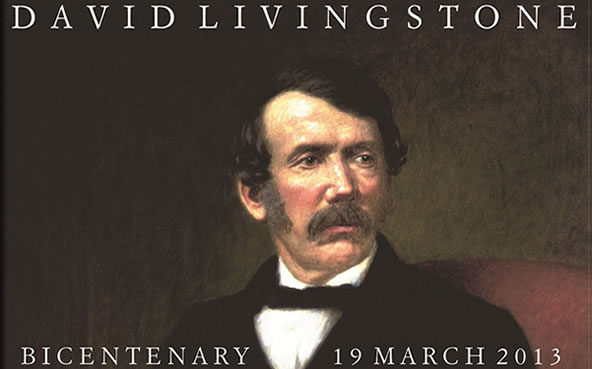
David Livingstone, uncommon Christian missionary-explorer . . . 200th anniversary of his birth, March 19, 2013 . . . events and exhibits in Africa, U.K., USA, Canada


“I have found that I have no unusual endowments of intellect, but I this day resolved that I would be an
uncommon Christian.”


So wrote a young David Livingstone (1813–1873) prior to his initial departure for Africa.

Though not widely known today, the inspiration behind Livingstone’s resolution is James Brainerd Taylor (1801–1829). The Princeton University and Yale Seminary-educated evangelist in the Second Great Awakening was a household name in mid-19th-century America and Great Britain.

As learned from the Memoir of James Brainerd Taylor (1833), Taylor defined an "uncommon Christian" as one who is an “eminently holy, self-denying, cross-bearing, Bible, everyday” Christian.

Probably the most widely known person who was influenced and inspired by Taylor’s Uncommon Christianity was Livingstone.

Henry Morton Stanley: "Dr. Livingstone, I presume?"
David Livingstone: “Yes, and I feel thankful that
I am here to welcome you.”
November 10, 1871     Ujiji, Tanzania, Africa
Presumably in a diary entry, the famed Scottish pioneer missionary-explorer to Africa wrote (and as quoted above),
I have found that I have no unusual endowments of intellect, but I this day resolved that I would be an uncommon Christian.
Elsewhere, in a May 5, 1839, letter to his younger sister Janet, it is clearly known that Livingstone read and was influenced by the Memoir of James Brainerd Taylor.

James Brainerd Taylor
1801-1829
At the time of writing, the memoir’s popularity was at its peak in the U.S. and U.K. (a London edition appeared in 1834 by the publisher Westley and David), and the 26-year-old Livingstone was 19 months shy of leaving for Africa.

In the U.S. in the mid-1800s, Taylor's memoir was the 5th most printed memoir by the largest Christian publisher at the time, the American Tract Society. Jonathan Edwards' biography on Taylor's cousin, David Brainerd (1718-1747), was the 2nd most printed memoir by ATS.

In the letter—which is housed at the National Library of Scotland’s John Murray Archive in Edinburgh—Livingstone makes reference to “Mr. J. B. Taylor” and “uncommon Christians” (with “uncommon” underlined for emphasis). He then cites the American evangelist almost verbatim.

At the time, the London Missionary Society (est. 1795) candidate Livingstone was studying theology under a pastor in Ongar, England. And his sister was a teacher in their native Blantyre, Scotland.

Livingstone quotes from a May 11, 1823, letter that Taylor wrote while a student at New Jersey’s Lawrenceville Academy.

John Murray Archive.
National Library of Scotland.
In the letter, the 22-year-old Lawrentian quotes from his own journal entry that describes his dramatic “second conversion” (assurance of salvation) experience in Haddam, Connecticut, on April 23, 1822.
--> See John Holt Rice (1777-1831) and Benjamin Holt Rice (1782-1856), Memoir of James Brainerd Taylor, 2nd Ed. (New York: American Tract Society, 1833), 82-90. Memoir available online at Google Books and Archive.org.

Quoting the entire section for the sake of context, Livingstone states to his “dear sister,”
“The hand of the diligent maketh rich.” [Proverbs 10:4.]
This is true not only with respect to the things of this world, but also in reference to that, the possession of which is of far more consequence then all the other good things in the whole universe: the attainment of holiness, eminent holiness. We have the highest inducement to diligence in seeking this.
“They who hunger and thirst after righteousness shall be filled.” [Matthew 5:6.]
"Pray without ceasing.” [1 Thessalonians 5:17.]
And, “Whatsoever we ask” the Father in Christ’s name, “believing, we shall receive.” [Matthew 21:22.]
Let us ask perseveringly, earnestly, and with a determination never to rest content till we have attained, what Mr. J. B. Taylor used to term, the state of being uncommon Christians, that is, “eminently holy and devoted servants of the Most High" [James Brainerd Taylor, quotation marks not in the original].
Let us seek—and with the conviction that we cannot do without it—“that all selfishness be extirpated, pride banished, unbelief vanish[ed] from the mind, every idol dethroned, and everything hostile to holiness and opposed to the divine will crucified; that ‘holiness to the Lord’ may be engraved on the heart [Exodus 28:36, 39:30], and evermore characterize our whole conduct” [James Brainerd Taylor, quotation marks not in the original]. This is what we ought to strive after; this is the way to be happy; this is what our Savior loves: entire surrender of the heart.
May He enable us by His Spirit to persevere till we attain it. All comes from Him, the disposition to ask as much as the blessing itself. “Every good gift,” every grace “comes from the Father of lights” [James 1:17]. Let us bless him if he has given any desire after him and his Savior, and take it as a pledge of better things to come.
We must not rest satisfied with desires, never draw any comfort from our feelings. But only be content with the blessings themselves when conscious of resting on the Lord Jesus. Never look within but constantly away from ourselves to the blessed cure for our maladies, which is ever open and always free. 
Livingstone Cottages.
(Formerly called Chapel Cottages.)
Ongar, Essex, England.
This is where Livingstone penned
his May 5, 1839, letter.

Livingstone Cottages.
Ongar, Essex, England.


In one of the first exhaustive biographies on Livingstone, William Garden Blaikie quotes from a portion (approximately one-fifth) of the above May 5, 1839, letter by Livingstone. With a massive amount of Livingstone manuscripts at his disposal, the professor at New College, Edinburgh, no doubt had to be selective regarding what to include, and what not to include, in his 500-plus page volume.

In The Personal Life of David Livingstone (New York: Revell, 1880, free online copy here), Blaikie omits “Mr. J. B. Taylor,” maybe with the thought that the specific human source of Livingstone’s “uncommon Christians” remark is inconsequential.

And because Livingstone himself does not use quotation marks, the Scottish biographer is understandably unaware that Livingstone is actually citing “Mr. J. B. Taylor” in the section of the 1839 letter that he does include. Blaikie (1820-1899) simply writes, “Alluding to the remark of a friend that they should seek to be ‘uncommon Christians, that is, eminently holy and devoted servants of the Most High. . .’” (page 46).

The impression is given that the anonymous friend is a contemporary of Livingstone, possibly a friend (perhaps good friend D. G. Watt), fellow ministerial apprentice, or even his pastor-mentor, the Rev. Richard Cecil. And that the section “all selfishness be extirpated, pride banished, unbelief vanish[ed] from the mind, every idol dethroned,” etc., and expansion of what it means to be an “uncommon Christian” (“eminently holy and devoted servants of the Most High”), are Livingstone’s own words and not those of his anonymous “friend.”

Despite the omission of “Mr. J. B. Taylor” by Blaikie—and subsequently every Livingstone biographer since Blaikie’s hagiographical The Personal Life of David Livingstone—and despite the lack of quotation marks by Livingstone (and subsequently Blaikie and every Livingstone biographer since), that the anonymous “friend” is the “uncommon Christian” American evangelist James Brainerd Taylor (1801–1829), a.k.a. “Mr. J. B. Taylor,” can be deduced with certainty.

To visit, click here.
Bicentennial Events and Exihbits in Africa & U.K.

Here are 4 major online resources and events in honor of the 200th anniversary of David Livingstone's birth:

+ Livingstone200.org
Frontline Fellowship: Serving Persecuted Churches in Africa
Cape Town, South Africa
Dr. Peter Hammond, Founder & Director (est. 1982)
--> Frontline Fellowship USA branch (Manitou Springs, Colo.)

+ DavidLivingstone200.org
National Trust of Scotland, Scotland Malawi Partnership, the Scottish government, etc.

+ Livingstone2013.com
Livingstone, Zambia

+ Westminster Abbey Bicentenary Commemoration
London, England
March 19, 2013 (6:30 p.m.)
--> The ceremony is being attended by Livingstone and Moffat family members, church bodies, medical professionals, government officials, MPs and MSPs and many others with a deep regard for Livingstone and his legacy  . . . Livingstone's wife Mary (1821-1862) was the daughter of Robert and Mary Moffat, Scottish missionaries to Africa
--> Livingstone's grave and inscription

ALSO, see:

--> "Dr. Livingstone: A 200-year Legacy," BBC News, March 18, 2013

--> "Events mark birth date of explorer Dr David Livingstone," BBC News, March 19, 2013

--> "Celebrating David Livingstone, 'Africa's first freedom fighter': Born to mill-workers living in a single room in Blantyre near Glasgow 200 years ago, David Livingstone's life and legacy as an explorer and humanitarian is being celebrated across the UK and Africa," "The Scotland Blog," The Guardian (U.K.), March 19, 2013

--> "Meeting David Livingstone's Descendants," Scotsman.com (Edinburgh), March 20, 2013

To visit, click here.


Bicentennial Events in USA
(for Canada, scroll to very end)

While American commemorative events are understandably yet sadly few, Uncommon Christian Ministries (est. 2007) is presenting a paper/lecture at the following academic conferences and church. For a copy of the paper, contact UCM

“Resolved that I would be an uncommon Christian”:
The Influence of the “Uncommon Christian”
James Brainerd Taylor on David Livingstone

In Honor of the Bicentennial of Livingstone’s Birth (March 19, 2013) 
Pacific Northwest annual regional meeting
March 9, 2013 (3:00 p.m.)
Church For All Nations
Tacoma, WA

Pacific Northwest annual regional meeting
April 6, 2013 (10:45 a.m.)
Multnomah Biblical Seminary
Portland, OR

Biennial national spring meeting (and ASCH's 125th anniversary)
April 6, 2013 (4:00 p.m.)
Crowne Plaza Hotel Conference Center
Portland, OR

First Baptist Church
47th annual missions conference
May 14, 2013 (7:00 p.m.)
Marysville, WA

ALSO:
Evangelical Theological Society
Midwest annual regional meeting 
April 10, 2015 (11:00 a.m.)
Moody Bible Institute
Chicago, IL

Evangelical Theological Society
67th annual national meeting
November 19, 2015 (2:40 p.m.)
Atlanta Hilton Hotel
Atlanta, GA

Maybe see some of you in Marysville, Tacoma or Portland? Come and bless us with your presence!

If desiring a copy of the paper--or a more informal PowerPoint presentation at your church or meeting--contact UCM.
--> NOTE: The 139 PowerPoint slides are available here. They are borrowed from Dr. Peter Hammond of Frontline Fellowship, Cape Town, South Africa, and Frontline Fellowship USA.

Also, for a map created by Uncommon Christian Ministries entitled "The Global and Cross-Cultural Impact of the American Evangelist James Brainerd Taylor (1801–1829) and His Two Memoirs (1833, 1838)," see here.

Livingstone's grave. (See here for text.)
Westminster Abbey. London.
Issue 56 (Vol. XVI, No. 4). 1997. Christian History.
To order, or to view the free online copy, see here.


To visit, click here.
"Dr. Livingstone attacked by a lion."

Birthplace of Livingstone. March 19, 1813.
David Livingstone Centre.
Blantyre, South Lanarkshire, Scotland.


To visit, click here.

"Imperial Obsessions: David Livingstone, Africa and world history: a life and legacy reconsidered."
Academic conference. April 19-21, 2013. Livingstone, Zambia.

To visit, click here.

Bicentennial Exhibit in Canada

"Dr. Livingstone, I Presume?"
& "David Livingstone: Magic Lantern Series" (in Belvedere Gallery)

March 19 - August 31, 2013

Castle Kilbride (1877, designated national historic site 1994)
Baden, Ontario

David Livingstone, a Waterloo resident and great-great-grandson of John Livingstone (1811-1899, older brother to the famed David Livingstone), donated artifacts to the exhibit, as did the Museum of Health Care Kingston, Stratford-Perth Archives and Waterloo Region Museum.


Of this lone Canadian exhibit, see:

"Dr. Livingstone, I Presume - in Baden: Exhibit shows location connection to explorer David Livingstone," The Record (Kitchener, Ont.), March 10, 2013

"Dr. Livingstone, I Presume?", Waterloo Chronicler, March 13, 2013

"Exhibit shows Waterloo connection to explorer David Livingstone," MetroNews.ca, March 11, 2013

Canada

David Livingstone.
Waterloo, Ontario, Canada.
March 2013.

Great-great-grandson of John Livingstone (1811-1899),
Canadian immigrant and older brother

of the famed David Livingstone.

Photo by Brent Davis. The Record. Kitchener, Ont.
Canada

John Livingstone (1811-1899).

Older brother of David Livingstone.
Pictured with his grandson.

Immigrated to Ontario, Canada, in 1840.

Lived in Lanark County in eastern Ontario, 1840-60.

ListowelPerth County in southwestern Ontario, 1860-99.

Buried in Fairview Cemetery in Listowel, Ontario.

Canada

Northwest face of Thunder Mountain in the Livingstone Range,
a sub-range of the Canadian Rockies in southeastern Alberta, Canada.


The range was named after David Livingstone in 1858 by Thomas Blakiston (1832-1891),
an assistant to the Irish-born geographer and explorer John Palliser (1817-1887).
When British-born "Forgotten Explorer" Peter Fidler (1769-1822) climbed Thunder Mountain

in 1792, he became the first European to make a recorded ascent in the Canadian Rockies.

There exists a Mount Livingstone in both Alberta (7,948 feet [2,422 meters])
and British Columbia (10,150 feet [3,094 meters], so named in 1927).

Adjacent to B.C.'s Mount Livingstone is Mount Stanley (10,138 feet [3090 meters]),
named after Henry Morton Stanley (1841-1904), the New York Herald journalist
of "Dr. Livingstone, I presume?" fame.